
Frontline Worker Hiring Trends 2026: Employee Referral Statistics Every Operations Leader Needs To Know
December 8, 2025
Frontline Worker Hiring Trends 2026: Employee Referral Statistics Every Operations Leader Needs To Know
Frontline workforces power the core of many industries, including retail, hospitality, logistics, transportation, facilities, warehousing, and customer support. As hiring challenges intensify in these sectors, organizations are turning to employee referral programs as one of the most reliable ways to find qualified workers, reduce turnover, and stabilize shift based operations.
Frontline hiring in 2026 requires speed, simplicity, and cost effectiveness. Referral programs deliver all three, while also improving reliability and retention across frontline roles. This blog breaks down the latest frontline referral statistics and explores why referrals have become a critical part of workforce strategy.
Key Employee Referral Statistics for Frontline Workers in 2026
Below is a complete summary of the frontline worker referral data.
Adoption and Usage
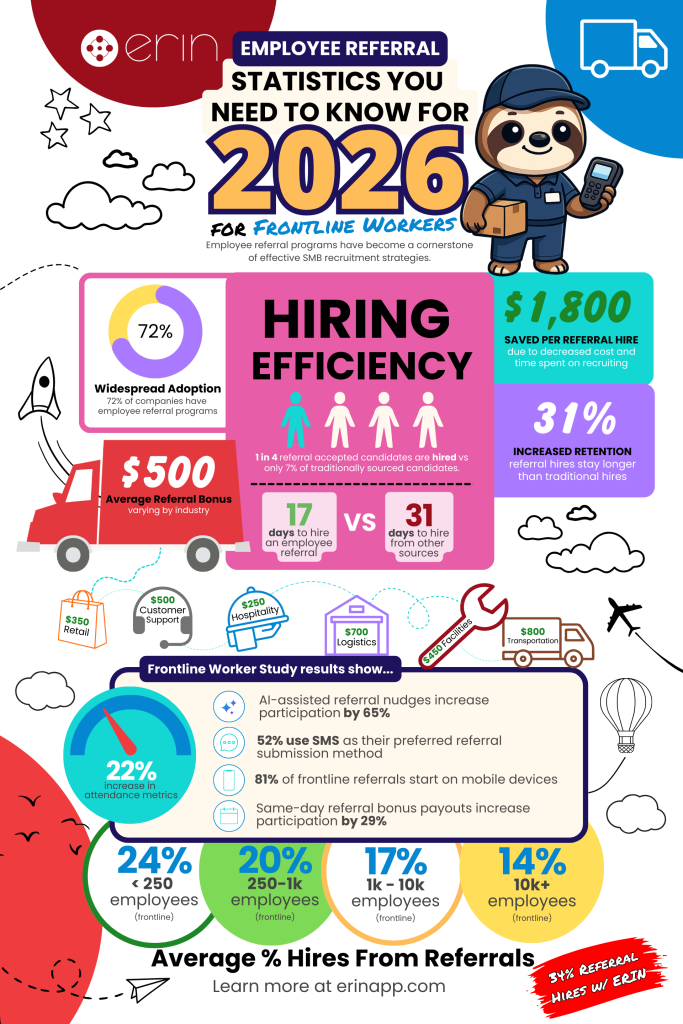
72 percent of companies employing frontline workers have an employee referral program.
Frontline referrals are now considered a core hiring channel in high volume, shift based environments.
Hiring Efficiency
17 days to hire a frontline referral.
31 days to hire from traditional sources.
1 in 4 referral accepted candidates are hired.
Only 7 percent of traditional applicants are hired.
Cost Savings and ROI
1,800 dollars saved per referral hire because of reduced sourcing costs, lower ad spend, and less backfill overtime.
Retention and Reliability
Referral hires have a 31 percent higher retention rate than traditional frontline hires.
Referred frontline employees show a 22 percent increase in attendance metrics.
AI assisted referral nudges increase participation by 65 percent.
Frontline Referral Bonus Averages
Retail: 350 dollars
Customer Support: 500 dollars
Logistics: 700 dollars
Hospitality: 250 dollars
Facilities: 450 dollars
Transportation: 800 dollars
Average frontline referral bonus: 500 dollars
Mobile First Referral Behavior
81 percent of frontline referrals start on mobile devices.
52 percent of frontline workers prefer SMS as their referral submission method.
Same day referral bonus payouts increase participation by 29 percent.
Percent of Hires From Referrals by Organization Size
Companies with fewer than 250 frontline employees: 24 percent
Companies with 250 to 1,000 frontline employees: 20 percent
Companies with 1,000 to 10,000 frontline employees: 17 percent
Companies with more than 10,000 frontline employees: 14 percent
Companies using ERIN average more than 34 percent of frontline hires coming from referrals.
Employee Referral Programs Are Becoming Essential in Frontline Hiring
Frontline hiring challenges continue to grow. These roles tend to involve high turnover, tight margins, unpredictable staffing needs, and a constant need for reliable, dependable employees. Referral programs help organizations overcome these challenges by connecting them with candidates who already understand the demands of frontline work.
Frontline workers often maintain strong social networks with others in similar roles. Referral programs give employers access to these networks and allow them to acquire talent more quickly and efficiently than job boards or traditional recruiting channels.
Referrals also help employers build a more stable workforce by bringing in employees who are more likely to show up, stay longer, and deliver stronger performance.
Referrals Improve Hiring Speed in Shift Based, High Volume Environments
Frontline operations depend on speed. Whether it is an understaffed retail floor, a call center with rising queue times, or a logistics operation that needs to move freight on time, open roles have an immediate operational impact.
Referral hires take 17 days on average to fill, compared to 31 days for non referral hires. This speed difference helps employers maintain coverage, reduce overtime, and avoid service disruptions.
Referred candidates tend to respond faster, communicate more clearly, and require less screening. For hiring managers with limited time and resources, this creates a meaningful advantage.
Referred Frontline Employees Deliver Stronger Retention and Attendance
Retention is one of the largest challenges in frontline industries. High turnover leads to constant rehiring, retraining, and operational instability. Referral hires help solve this by staying longer and showing better reliability.
Referral hires have a 31 percent higher retention rate compared to traditional frontline hires. They also show a 22 percent increase in attendance metrics, which is one of the most important indicators of frontline performance.
When employees bring in people they trust, those new hires tend to feel more supported, more connected, and more committed to the team.
Referral Programs Reduce Frontline Hiring Costs by an Average of 1,800 Dollars Per Hire
Frontline hiring can be expensive because of high turnover, repeated job postings, agency spending, and supervisor time spent interviewing. Referral programs reduce these expenses by creating a steady pipeline of prequalified candidates who require less sourcing effort.
When frontline roles are filled faster and employees stay longer, companies reduce overtime, training costs, and the drain on managerial bandwidth. For large multi location operations, these savings multiply quickly.
Frontline Referral Bonuses Are Practical and Effective
Bonus amounts for frontline referrals are typically smaller than those in clinical, enterprise, or technical roles, but they are highly effective because frontline employees value immediate rewards.
Retail and hospitality organizations often offer bonuses between 250 and 500 dollars. Logistics, transportation, and facilities roles tend to fall between 450 and 800 dollars.
Same day payout options increase referral activity by 29 percent, showing that timing is as important as the amount.
The Rise of Mobile First Referral Engagement in Frontline Environments
The frontline workforce is overwhelmingly mobile. Most employees do not work at desks, read long emails, or spend time in internal HR systems. This makes mobile driven referral engagement essential.
Eighty one percent of frontline referrals begin on a mobile device, and 52 percent of frontline workers prefer to submit referrals via SMS. Employers that adopt mobile first referral technology see higher participation and more consistent referral volume.
AI driven engagement further enhances performance by reminding employees to refer, recommending roles, and personalizing outreach. This is especially important for frontline teams that work unpredictable schedules or multiple shifts.
Referral Performance Benchmarks for Frontline Organizations
The percentage of hires coming from referrals varies by organizational size, but even smaller frontline teams achieve strong referral results. Larger operations continue to see double digit referral contributions, and companies with structured referral platforms reach more than 34 percent of hires from referrals.
These benchmarks help frontline operations leaders evaluate their program strength and set realistic goals for improvement.
How Frontline Organizations Can Strengthen Referral Performance in 2026
Use mobile first workflows that support SMS submissions
Offer same day bonus payouts to boost participation
Promote urgent openings through targeted referral campaigns
Use AI automation to increase engagement and consistency
Reward participation transparently and frequently
Track metrics like attendance, retention, and time to fill
The Bottom Line: Referral Programs Are the Most Powerful Hiring Strategy for Frontline Workforces in 2026
Employee referral programs offer unmatched value for frontline employers. They improve attendance, reduce turnover, lower hiring costs, and speed up the recruiting process in industries where operational efficiency is essential.
With the help of mobile first referral platforms and AI driven engagement, frontline organizations can build a stronger, more reliable workforce and significantly improve hiring outcomes in 2026 and beyond.