
Healthcare Employee Referral Statistics You Need to Know for 2025: Transforming Healthcare Recruitment
November 25, 2024
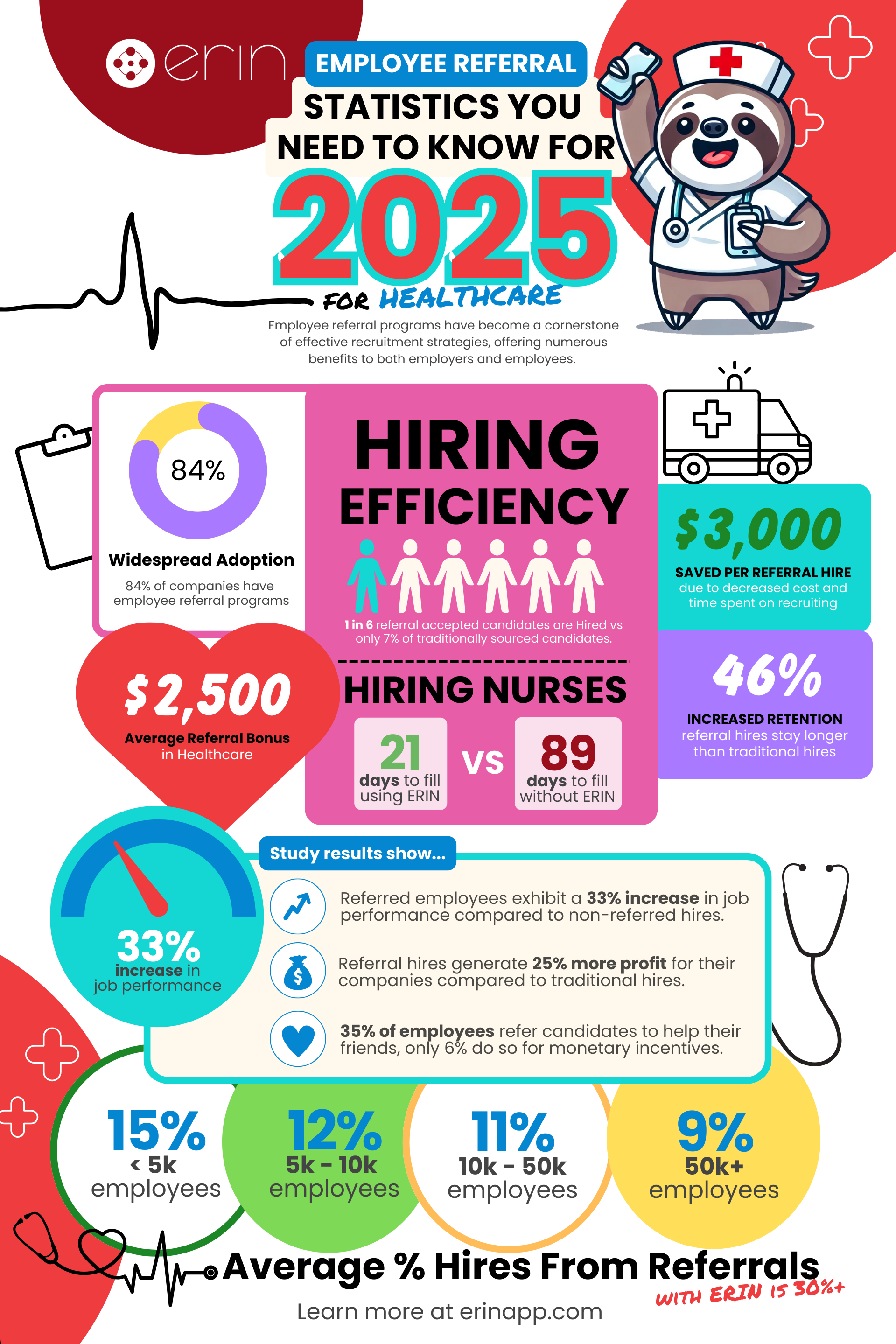
The healthcare industry faces unique hiring challenges, including high turnover rates and the urgent need for skilled professionals. Employee referral programs are proving to be a game-changer in this space, providing healthcare organizations with a reliable, cost-effective way to attract and retain top talent. Our latest infographic, “Employee Referral Statistics for 2025: Healthcare Edition,” highlights key data showcasing the effectiveness of referrals in this critical industry.
1. Referrals Are Driving Hiring Efficiency in Healthcare
In the fast-paced world of healthcare, every second counts—both in patient care and recruitment:
- Referral programs are widely embraced, with 84% of companies using them as part of their recruitment strategies.
- Referrals offer a hiring efficiency unmatched by traditional methods:
- It takes just 21 days to fill a nursing position using ERIN, compared to a staggering 89 days without it.
- Additionally, referral hires save organizations $3,000 per hire, thanks to lower recruiting costs and faster onboarding.
2. High Retention and Performance with Referral Hires
Healthcare organizations can’t afford to gamble on talent retention. Luckily, referral hires provide a solution:
- Referral hires show 46% higher retention rates than traditionally sourced employees.
- Referred employees outperform their peers, with a 33% increase in job performance.
- They also drive greater profitability, generating 25% more profit for their organizations.
3. Competitive Referral Bonuses in Healthcare
The healthcare industry recognizes the value of referrals and incentivizes them accordingly:
- The average referral bonus in healthcare is $2,500, providing a compelling reason for employees to recommend qualified candidates.
- These bonuses reflect the industry’s emphasis on attracting top-tier talent quickly and efficiently.
4. Why Healthcare Employees Refer
While referral bonuses are attractive, most healthcare employees refer for altruistic reasons:
- 35% of employees refer candidates to help their friends or improve their teams.
- Only 6% refer solely for financial incentives.
This sense of purpose aligns with the values of healthcare professionals, making referrals a natural fit for this industry.
5. Referrals by Organization Size
The impact of referrals varies across healthcare organizations of different sizes:
- Smaller organizations (<5,000 employees) see 15% of their hires coming from referrals.
- Midsize organizations (5,000–10,000 employees) achieve 12% of hires through referrals.
- Larger enterprises (10,000–50,000 employees) and major hospital systems (50,000+ employees) report 11% and 9%, respectively.
However, organizations using ERIN consistently outperform, with 15%+ of their hires coming from referrals, regardless of size.
Conclusion: A Vital Tool for Healthcare Hiring
In an industry where talent shortages can directly impact patient care, healthcare organizations need innovative solutions to fill critical positions. Employee referral programs not only reduce time-to-hire but also ensure higher retention and better performance—three essential factors for success in 2025.
With tools like ERIN, healthcare organizations can harness the full potential of referrals, filling positions like nursing roles in just 21 days and achieving an overall hiring efficiency that transforms their recruitment strategy.
Learn more about how ERIN can revolutionize your employee referral program at erinapp.com. With ERIN, you can turn referrals into a strategic advantage that meets the unique challenges of healthcare hiring.
If you’re ready to optimize your recruitment process and build a stronger, more reliable workforce, it’s time to make referrals your top priority. Start now and see the difference in 2025!