
Enterprise Employee Referral Statistics for 2027
October 13, 2026
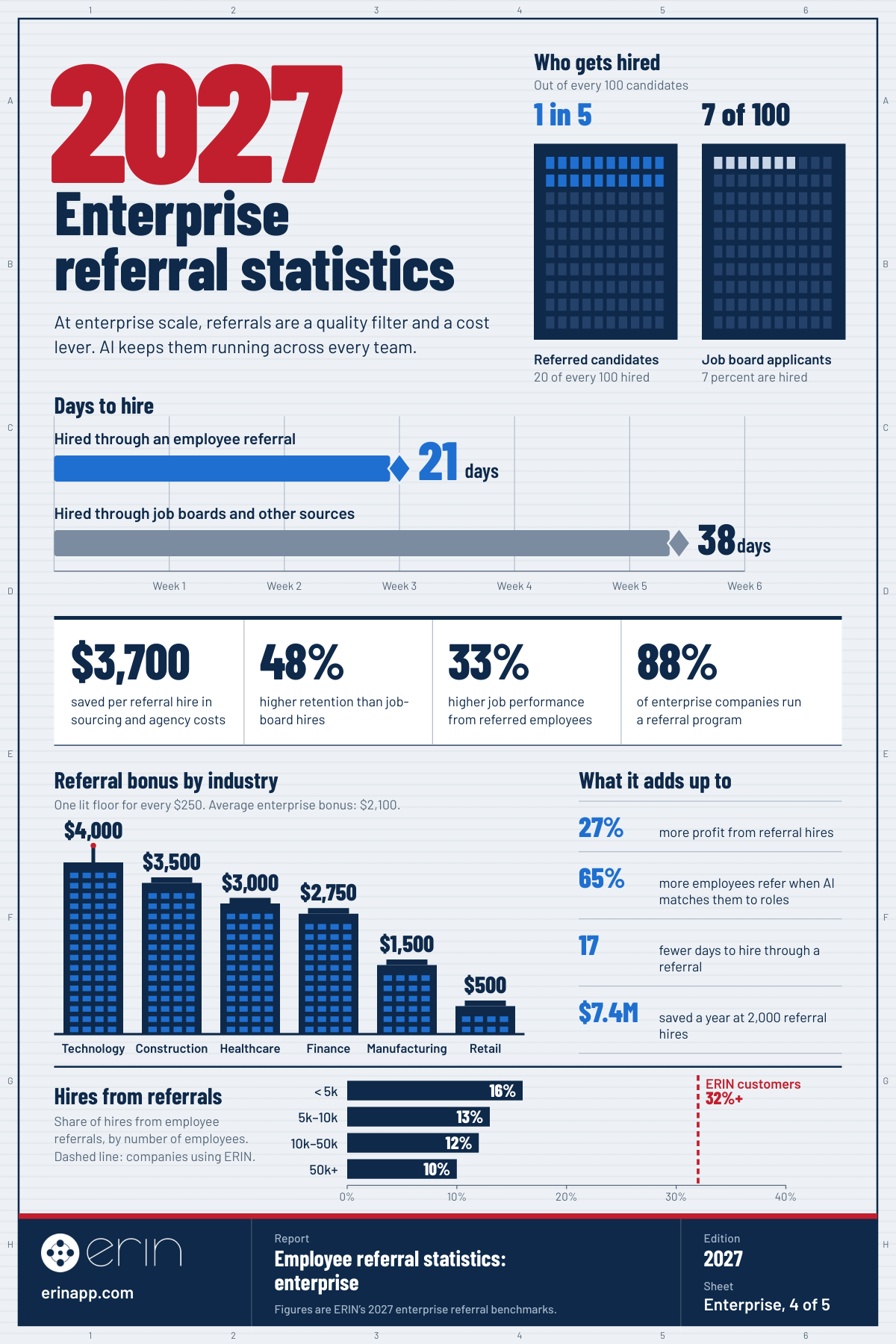
Enterprise hiring in 2027 is a tale of two markets. Corporate and office hiring has cooled, while operations, field, and skilled roles remain fiercely competitive. Large organizations need a channel that works in both: one that surfaces quality candidates for specialized roles and scales across thousands of locations and job families.
Employee referrals are that channel. This post breaks down the 2027 enterprise referral statistics, what changed from last year, and how large organizations can make referrals a predictable part of their hiring engine.
Key Employee Referral Statistics for Enterprise Companies in 2027
Adoption and Usage
- 88 percent of enterprise companies have an employee referral program, up from 87 percent in 2026.
- Referrals are a foundational component of enterprise talent acquisition.
Hiring Efficiency
- 21 days to hire an employee referral, down from 22.
- 38 days to hire from other sources, up from 37.
- 1 in 5 referral accepted candidates are hired.
- Only 7 percent of traditional applicants are hired.
Cost Savings and ROI
- $3,700 saved per referral hire, up from $3,500, through lower sourcing, agency, and recruiter-time costs.
Retention and Performance
- Referral hires have a 48 percent higher retention rate.
- Referred employees show a 33 percent increase in job performance.
- Referral hires generate 27 percent more profit.
- AI-assisted referral nudges increase participation by 65 percent.
Referral Bonus Averages by Industry
| Industry | 2027 average bonus | 2026 average bonus |
|---|---|---|
| Technology | $4,000 | $4,500 |
| Construction | $3,500 | $3,200 |
| Healthcare | $3,000 | $2,800 |
| Finance | $2,750 | $2,750 |
| Manufacturing | $1,500 | $1,100 |
| Retail | $500 | $500 |
| Average enterprise referral bonus | $2,100 | $2,000 |
Percent of Hires From Referrals by Company Size
- Fewer than 5,000 employees: 16 percent
- 5,000 to 10,000 employees: 13 percent
- 10,000 to 50,000 employees: 12 percent
- More than 50,000 employees: 10 percent
Companies using ERIN average more than 32 percent of hires from referrals.
What Changed for 2027
- Technology bonuses came down. With corporate tech hiring softer and applicant volume high, enterprise technology bonuses eased from $4,500 to $4,000.
- Construction and manufacturing bonuses went up. Data center buildouts, reshoring, and electrification are pulling electricians, technicians, and maintenance staff in every direction. Manufacturing bonuses rose from $1,100 to $1,500 and construction from $3,200 to $3,500.
- Referrals got faster while other channels got slower. The gap between referral and traditional time to hire widened to 17 days.
- Quality filtering matters more. As AI-generated and fraudulent applications rise, a referral from a trusted employee is one of the strongest authenticity signals a recruiter can get.
Referrals Dramatically Improve Hiring Speed
Delays in filling critical roles slow projects, strain teams, and raise labor costs. Referral hires take 21 days on average, compared to 38 days for traditional sources.
Referred candidates move faster because they arrive engaged, trust the opportunity, and understand the role from someone who already does it.
Referred Employees Significantly Outperform Traditional Hires
Referred enterprise employees show a 33 percent increase in job performance and generate 27 percent more profit than traditionally sourced hires. Referrers understand both the candidate and the work, and that context leads to better matches across sales, service, engineering, operations, and leadership.
Referral Hires Deliver Higher Retention
Turnover is expensive at enterprise scale. Referral hires have a 48 percent higher retention rate, helping large companies maintain continuity, protect training investments, and reduce churn-related costs. Built-in social support and clearer expectations lead to longer tenure.
Enterprises Save an Average of $3,700 Per Referral Hire
Enterprises spend heavily on job boards, programmatic ads, sourcing tools, agencies, and contract recruiters. At $3,700 saved per referral hire, an organization making 2,000 referral hires a year saves more than $7.4 million. Those savings can fund employer brand, learning, and retention programs.
Referral Bonus Trends in Enterprise Industries
Bonuses now track the labor market more closely than ever. Skilled and field roles are rising, corporate roles are flat or falling, and retail remains steady. The right amount depends on scarcity, vacancy cost, and internal pay strategy.
Most employees refer for more than money. They want better coworkers and stronger teams, so recognition and fast follow-up matter alongside the bonus.
AI-Powered Referral Engagement Is Transforming Enterprise Hiring
AI-assisted nudges increase participation by 65 percent and let enterprises scale referrals without adding manual work. AI identifies likely referrers, recommends jobs to the right employees, and keeps engagement consistent across business units where communication often gets diluted.
How Enterprise Organizations Can Strengthen Referral Performance in 2027
- Make referrals easy and mobile for every employee, including deskless teams.
- Use AI-powered engagement to drive participation.
- Set bonuses by role scarcity, not one flat amount.
- Promote high-priority roles with targeted campaigns.
- Respond to every referral quickly and keep referrers updated.
- Track ROI metrics including performance, retention, and time to hire.
The Bottom Line
Enterprises with strong referral programs hire faster, retain longer, and spend less. In a split labor market, referrals give large organizations a quality filter for high-volume corporate roles and a direct line to scarce skilled talent. With AI running the engagement, referrals can be a predictable, scalable hiring engine for 2027 and beyond.
About this data: figures reflect ERIN’s 2027 enterprise referral benchmarks, updated from our 2026 report to reflect current labor-market conditions.
Download the 2027 Enterprise referral statistics infographic
Download the free PDF · View the full-size PNG · Explore ERIN
Sources and benchmark context
Referral statistics in this article are attributed to ERIN's supplied 2027 enterprise benchmark report. They are not national labor-market averages or guaranteed results. The supplied report does not specify sample size, observation period, or metric definitions.