
Frontline Hiring Trends & Referral Statistics for 2027
October 13, 2026
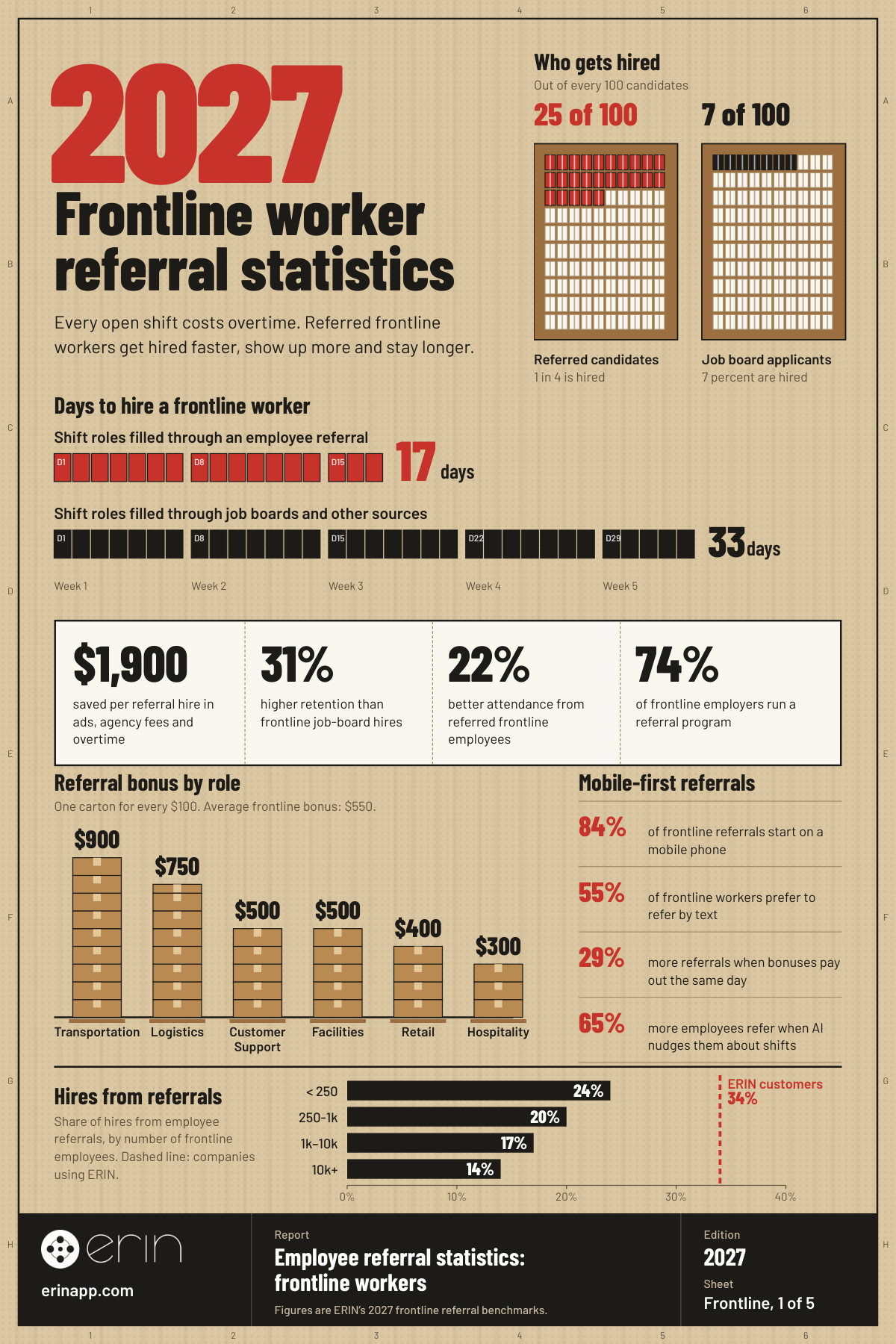
Frontline workforces run retail floors, warehouses, distribution centers, hotels, call centers, facilities, and fleets. Heading into 2027, those operations are still fighting the same battle: high turnover, constant backfilling, and open shifts that hit service levels the day they go unfilled.
Employee referral programs have become one of the most dependable answers. Referred frontline workers get hired faster, show up more consistently, and stay longer. This post breaks down the 2027 frontline referral statistics, what changed from last year, and how operations leaders can get more from their programs.
Key Employee Referral Statistics for Frontline Workers in 2027
Adoption and Usage
- 74 percent of companies employing frontline workers have an employee referral program, up from 72 percent in 2026.
- Referrals are now a core hiring channel in high-volume, shift-based environments.
Hiring Efficiency
- 17 days to hire a frontline referral.
- 33 days to hire from traditional sources, up from 31 days as job-board applicant quality continues to slip.
- 1 in 4 referral accepted candidates are hired.
- Only 7 percent of traditionally sourced applicants are hired.
Cost Savings and ROI
- $1,900 saved per referral hire, up from $1,800, driven by rising wages, ad spend, and overtime used to cover open shifts.
Retention and Reliability
- Referral hires have a 31 percent higher retention rate than traditional frontline hires.
- Referred frontline employees show a 22 percent increase in attendance metrics.
- AI-assisted referral nudges increase participation by 65 percent.
Frontline Referral Bonus Averages
| Role category | 2027 average bonus | 2026 average bonus |
|---|---|---|
| Transportation | $900 | $800 |
| Logistics | $750 | $700 |
| Customer Support | $500 | $500 |
| Facilities | $500 | $450 |
| Retail | $400 | $350 |
| Hospitality | $300 | $250 |
| Average frontline referral bonus | $550 | $500 |
Mobile-First Referral Behavior
- 84 percent of frontline referrals start on a mobile device, up from 81 percent.
- 55 percent of frontline workers prefer SMS as their referral submission method, up from 52 percent.
- Same-day referral bonus payouts increase participation by 29 percent.
Percent of Hires From Referrals by Organization Size
- Fewer than 250 frontline employees: 24 percent
- 250 to 1,000 frontline employees: 20 percent
- 1,000 to 10,000 frontline employees: 17 percent
- More than 10,000 frontline employees: 14 percent
Companies using ERIN average more than 34 percent of frontline hires from referrals.
What Changed for 2027
The fundamentals held steady. Referral hires still convert at more than three times the rate of job-board applicants, and they still stay longer. Three things moved:
- The cost of a slow hire went up. Traditional time to hire stretched to 33 days, and every extra day means overtime, missed service levels, or agency labor.
- Bonuses rose where competition is fiercest. Transportation and logistics led the increases as drivers and warehouse workers stay in short supply. Facilities bonuses rose as maintenance roles increasingly compete with the skilled trades.
- Mobile became the default. Text and mobile links now account for the large majority of referral activity. A program that depends on email or a desktop portal misses most of the workforce.
Referrals Improve Hiring Speed in Shift-Based, High-Volume Environments
Frontline operations feel every open role immediately. An understaffed store floor, a call center with rising queue times, or a dock that cannot move freight on schedule all cost money by the shift.
Referral hires take 17 days on average, compared to 33 days for non-referral hires. That 16-day gap is the difference between covering a peak season and scrambling through it. Referred candidates respond faster, need less screening, and arrive with a realistic picture of the job from someone who already does it.
Referred Frontline Employees Deliver Stronger Retention and Attendance
Turnover is the defining challenge of frontline work. Every early exit means another posting, another round of interviews, and another week of training.
Referral hires have a 31 percent higher retention rate and a 22 percent increase in attendance metrics. When employees bring in people they trust, new hires feel supported from day one, and the referrer has a personal stake in their success.
Referral Programs Save an Average of $1,900 Per Frontline Hire
Frontline hiring gets expensive through volume. Repeated job postings, agency fees, supervisor interview time, and overtime to cover open shifts add up quickly across multi-location operations.
Referral programs create a steady pipeline of prequalified candidates. Filling roles faster and keeping people longer reduces every one of those costs, and the savings multiply with each location.
Frontline Referral Bonuses: Small, Fast, and Effective
Frontline bonuses are smaller than clinical or technical bonuses, but they work because frontline employees value immediate, visible rewards. Retail and hospitality programs typically land between $300 and $500. Logistics, transportation, and facilities roles run between $500 and $900.
Timing matters as much as the amount. Same-day payouts increase referral participation by 29 percent. A smaller bonus paid quickly often outperforms a larger bonus paid months later.
Mobile-First Referral Engagement Is Now the Standard
Most frontline employees do not sit at desks, read long emails, or log into HR systems. 84 percent of frontline referrals start on a phone, and 55 percent of workers prefer to submit by text.
AI-driven engagement closes the remaining gap by reminding employees to refer, recommending relevant roles, and timing outreach around shifts. AI-assisted nudges increase participation by 65 percent, which matters most for teams working nights, weekends, and rotating schedules.
How Frontline Organizations Can Strengthen Referral Performance in 2027
- Make text-to-refer and mobile links the primary referral path.
- Pay bonuses the same day or as close to it as possible.
- Run short, targeted campaigns for urgent openings and peak seasons.
- Use AI automation to keep participation consistent across shifts and locations.
- Recognize referrers publicly and frequently.
- Track attendance, 90-day retention, and time to fill alongside referral volume.
The Bottom Line
Employee referral programs deliver faster hires, better attendance, longer tenure, and lower costs for frontline employers. In 2027, the programs that win will be mobile-first, quick to pay, and powered by AI that keeps employees engaged between shifts.
About this data: figures reflect ERIN’s 2027 frontline referral benchmarks, updated from our 2026 report to reflect current labor-market conditions.
Download the 2027 Frontline referral statistics infographic
Download the free PDF · View the full-size PNG · Explore ERIN
Sources and benchmark context
Referral statistics in this article are attributed to ERIN's supplied 2027 frontline benchmark report. They are not national labor-market averages or guaranteed results. The supplied report does not specify sample size, observation period, or metric definitions.